
4 domande sulla valvola di controllo della pressione che dovresti sapere

Tempo di lettura stimato: 20 minuti
The pressure control valve uses the hydraulic force on the spool and the spring force to maintain a balance to work. Once this balance is broken, the opening or on-off of the valve port will change.
Pressure control valves are used to limit the maximum pressure in hydraulic systems, such as safety valvole, relief valves, etc.; used to adjust pressure, such as pressure reducing valves, back pressure valves, etc.; used to control a certain element or control a certain action, By using pressure signals, such as pressure relays.
The main basis for selecting pressure valvole is their role in the system, rated pressure, maximum flow, pressure loss value, working performance parameters, and service life. Usually, according to the maximum pressure of the hydraulic system and the flow rate through the valve, the specification of the pressure valve (pressure level and diameter) is selected from the product sample.
The pressure grade is divided according to the standard JB/T 824-66, low pressure, P≤2.5MPa; medium pressure, 2.5MPa<P<8.0MPa; medium and high pressure, 8.0MPa<P<16MPa; high pressure, 16MPa<P<32MPa; ultra-high pressure, P>32MPa.

Question 1: Pressure determination
1. The rated pressure of the pressure control valve should be greater than the highest pressure possible in the hydraulic system to ensure the normal operation of the pressure control valve.
2. The nominal pressure of the selected valve should be greater than 20%~~30% of the rated pressure of the system, or at least not less than the maximum pressure of the system (including the maximum pressure under dynamic conditions).
The highest pressure of low and medium pressure series hydraulic valves is 6.3MPa, which are mainly used for hydraulic transmission of machine tools.
The highest pressure of the medium and high-pressure series hydraulic valves is 32MPa, which are mainly used for hydraulic transmission of construction machinery and heavy machinery.
3. When the pressure control requirements are high, for example, when the control system pressure overshoot and opening time are required, the structure and dynamic performance of the selected valve must be considered.
4. Pay attention to the response time. The pressure control valve always has the process of pressure building and pressure relief. It should be noted whether these characteristics can meet the requirements of the system.
Question 2: Flow rate determination
1. The flow rate is the basis for selecting the valve diameter. When the system has restrictions on the pressure loss during unloading pressure or overflow, the diameter can be selected larger.
2. The actual flow through the pressure control valve should be less than the rated flow of the pressure valve. Among the models of Guangyan Institute’s series of low and medium pressure control valves, the main specifications give the rated flow of the valve. In the models of medium and high-pressure hydraulic control valves, the diameter is given, but for valves with the same diameter and different forms, their rated flow may not be the same under different pressures. If the pressure drop through the control valve is not high, the actual flow through the valve can also be slightly greater than the rated flow.

Question 3: Determine the structure type
According to the structure type and working principle, the pressure control valve is divided into two types: direct-acting type and pilot-operated type.
1. The direct-acting pressure control valve has a simple structure and high sensitivity, but the pressure is greatly affected by flow changes, and the pressure adjustment deviation is large, and it is not suitable for working under high pressure and large flow. However, in the buffer and brake devices, the pressure control valve is required to have high sensitivity, and a direct-acting relief valve should be used.
2. The sensitivity and response speed of the pilot-operated pressure control valve is lower than that of the direct-acting valve, and the pressure regulation accuracy is higher than that of the direct-acting valve. It is widely used in occasions where high pressure, large flow, and high-pressure regulation accuracy are required.
Avoid designing hydraulic circuits and selecting hydraulic valves from the principle without considering the structure. The selection of hydraulic valve must not only have the correct principle, but also consider the structure, such as sequence valve, the same working principle, but the structure is divided into internal leakage type and external leakage type, internal control type and external control type. The correct selection should be made according to the working state of the hydraulic system and the characteristics of the flow valve, otherwise, the system will not work normally.
Overflow valve
The overflow valve keeps the pressure of the controlled system or circuit constant through the overflow of the valve port, to realize the function of voltage stabilization, pressure regulation, or pressure limitation. The main requirements for the relief valve are large pressure regulation range, small pressure regulation deviation, small pressure swing, sensitive action, large flow capacity, and low noise.

Question 4: Selection of relief valve
1. Selection of direct-acting and pilot-operated relief valves
- The advantages of the direct-acting relief valve are simple structure, low manufacturing accuracy requirements, low cost; small resistance, relatively sensitive action; pressure overshoot is relatively small, but the stability process is longer. The disadvantage is that the pressure hysteresis is serious, and the control pressure is greatly affected by the overflow flow, which is prone to vibration, especially when it is close to shutting down, it is not suitable for working under high pressure and large flow. The sensitivity and response speed of the sub-type valve is lower than that of the direct-acting relief valve, and the pressure regulating accuracy is higher than that of the direct-acting valve. It is widely used in occasions where high pressure, large flow, and high pressure regulating accuracy are required.
- Improper selection results in slow relief valve action. The direct-acting type is the direct balance between hydraulic pressure and the spring force, and the pilot type is the balance between the inlet pressure and the spring force of the pilot valve and the spring of the main valve. If the pilot-operated relief valve is selected, when the pressure regulating screw or handle of the relief valve is tightened, the valve will turn from the unloading state to the pressure regulating state at the moment, the main valve core is close to the bonnet and the main valve is fully opened to overflow. When the pressure is increased, the main spool and the valve body maintain a small opening, and the time that the main spool of the relief valve falls from the unloading position to the opening required for pressure regulation is the rebound lag time of the relief valve.
- Due to improper selection, the lag time is longer and the relief valve moves slowly. The solution is to appropriately increase the diameter of the main spool orifice and reduce the lifting height of the main spool.
- The improper selection causes hydraulic shock. When the opening time of the overflow valve is longer than the requirement of the system, it will cause the pressure shock of the system or water hammer phenomenon. At this time, a poppet valve or direct-acting relief valve should be used.
2. Relief valve model
The maximum pressure of the P-type low-pressure relief valve is 2.5MPa, the low-pressure relief valve has no unloading port and cannot be used as an unloading valve; the maximum pressure of the Y type medium pressure relief valve is 6.3MPa; the maximum pressure of the YF type relief valve is 7~35MPa; HY The maximum pressure of type unloading relief valve is 0.6~32MPa; the maximum pressure of YE type DC electromagnetic relief valve is 6.3MPa; the maximum pressure of YFD type electromagnetic relief valve and YFE type electromagnetic relief valve is 0.6~32MPa.
3. Application restrictions

- Used to prevent the hydraulic system from overloading. As a safety valve, the overflow valve is used to prevent the system from being overloaded. This valve is normally closed; when the pressure in front of the valve does not exceed a preset limit, the valve is closed without spilling; when the pressure in front of the valve exceeds this limit value When the valve is opened immediately, the oil flows back to the tank or low-pressure circuit, thus preventing the hydraulic system from being overloaded. Safety valves are mostly used in systems with variable pumps, and the overload pressure controlled by them is generally 8% to 10% higher than the working pressure of the system.
- Used to keep the pressure of the hydraulic system constant. As a relief valve, in a quantitative pump system, it is connected in parallel with the throttling element and the load. At this time, the valve is always open and always overflows. With the different oil demands of the working mechanism, the overflow flow of the valve is sometimes large or small to adjust and balance the oil volume into the hydraulic system to make the pressure in the hydraulic system keep constant. However, due to the power loss of the overflow part, it is generally only used in low-power systems with fixed pumps. The adjustment pressure of the overflow valve should be equal to the working pressure of the system.
- Used for remote pressure regulation. Connect the oil inlet of the remote pressure regulating valve and the remote control port (unloading port) of the relief valve to realize remote pressure regulation within the set pressure range of the main relief valve.
- Used for unloading. Use the reversing valve to connect the remote control port (unloading port) of the overflow valve with the fuel tank to unload the oil circuit.
- Used for multi-level control of high and low pressure. When the reversing valve connects the remote control port (unloading port) of the overflow valve with several remote pressure regulating valves, multi-level control of high and low pressure can be realized.
- Used as a sequence valve. Process the top cover of the overflow valve to form a drain port, and block the axial hole connecting the main valve with the top cover, and use the main valve overflow port as the secondary pressure oil outlet, which can be used as a sequence valve.
- Used as an unloading relief valve. Generally used in pumps and accumulator systems. When the pump is working normally, it supplies oil to the accumulator. When the oil pressure in the accumulator reaches the required pressure, through the system pressure, the overflow valve is operated to unload the pump, and the system is supplied with oil from the accumulator and works as usual; When the oil pressure of the accumulator drops, the overflow valve is closed, and the oil pump continues to supply oil to the accumulator, thus ensuring the normal operation of the system.
4. Calculation of the set pressure of the relief valve
Usually, according to the maximum pressure of the hydraulic system and the flow rate through the valve, the specification of the relief valve (pressure level and diameter) is selected from the product sample. The set pressure of the relief valve is the supply pressure of the hydraulic pump
Py≥p+∑∆p
Where py is the set pressure of the overflow valve;
p is the maximum working pressure of the actuator of the hydraulic system;
∑∆p The total pressure loss of the hydraulic system, that is, the set pressure of the relief valve must be greater than the working pressure of the actuator and the sum of system losses.
If the overflow valve plays a safety role in the system, the set pressure of the overflow valve should be calculated by the following formula
Py ≥(1.05~1.1) p+∑∆p
The flow rate of the overflow valve is selected according to the rated flow of the hydraulic pump. When used as an overflow valve and unloading valve, it cannot be less than the rated flow of the pump, and when used as a safety valve, it can be less than the rated flow of the pump. For all kinds of pressure valves connected to the control oil circuit, because the actual flow through is very small, it can be selected according to the minimum rated flow specification of the valve, so that the hydraulic device has a compact structure.

Overflow valve circuit design
Remote control problem
- When using a remote control unloading relief valve, avoid excessive leakage of hydraulic components connected to its remote control port. As shown in Figure 5-1(a), when the hydraulic pump is started, the solenoid of the two-position four-way solenoid valve is energized, and the system pressure should rise to the set pressure, for example, 14MPa, if the leakage of the two-position four-way solenoid valve A is large, the set pressure cannot be reached, and only a lower pressure, such as 12MPa, can be reached. If valve A is replaced by valve B with a small leakage as shown in Figure 5-1(b), the system pressure can rise to the set pressure.
- Avoid connecting the pressure gauge to the remote control port of the overflow valve. When the hydraulic system is working, if the pressure gauge is connected to the remote control port of the overflow valve, the pointer of the pressure gauge will vibrate and the overflow valve will make a certain noise. Reconnect the pressure gauge to the oil inlet of the overflow valve, and the problem is solved. The reason is that the spring tube in the pressure gauge and the spring of the relief valve pilot valve are prone to resonance. It should also be pointed out that connecting the pressure gauge to the remote port of the overflow valve cannot correctly reflect the inlet pressure of the overflow valve.

Figure 1-1 (left) Connection of remote control valve
Figure 1-2 (right) The remote control port of the overflow valve is connected in series
- The order of the small relief valve and reversing valve connected in series to the remote control port of the relief valve should be paid attention to. As shown in Figure 1-2(a), the relief valve 1 and 3 and the reversing valve 2 form a two-stage pressure regulating circuit. For example, relief valve 1 is set to 14MPa, and relief valve 3 is set to 2MPa. When the solenoid is changed When the valve changes from power off to live, even if the system pressure changes from 14MPa to 2MPa, an impact occurs; and when the solenoid valve 2 and relief valve 3 are reversed as shown in Figure 1-2(b), The impact is almost eliminated. This is because before the solenoid valve 2 is energized in Figure (a), the oil inlet and outlet ports of the overflow valve 3 are all zero pressure, and when the solenoid valve 2 changes from de-energization to energization, the pressure of the overflow valve 1 The pressure of the remote control port has to drop to 0 and then rise to 2 MPa, resulting in an impact.
- The remote control port of the overflow valve must be tightly closed. When using the remote control port of the overflow valve, it is necessary to ensure that the valve connected to the port has a good sealing performance. As shown in Figure 1-3, it is a commonly used circuit that uses a remote control port to achieve pressure relief. In this type of circuit, if the spool of the reversing valve is severely worn or another leakage occurs, the set pressure of the system will be affected. Generally, the system pressure cannot reach the set value. Since the flow rate of the remote control port required to open the overflow valve is very small, the small flow caused by leakage will also cause the main valve of the overflow valve to slightly open, so that the system will begin to overflow before the set value is reached. When this happens, the reversing valve should be replaced immediately.
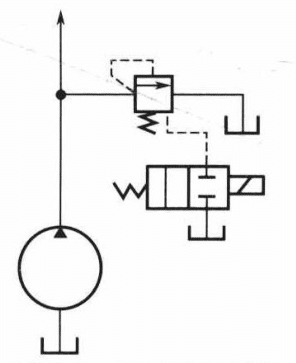
Figure 1-3 The remote control port of the overflow valve must be tightly closed
The problem of high-pressure unloading
When the pressure is high, if the relief valve is suddenly unloaded, the hydraulic pressure will be far greater than the spring force and be unbalanced, which will damage the spring. Excessive overflow will cause shock and vibration of the hydraulic cylinder, causing damage to the overflow valve and cylinder, resulting in economic losses and severely affecting normal operation.
Piping problems
The drain of the valve must be returned directly to the tank. Improper piping causes noise in the relief valve. As shown in Figure 1-4(a), the two hydraulic pumps supply oil to different actuators. When only one hydraulic pump is working, the overflow valve has no noise, and when the two hydraulic pumps are very close to each other and work at the same time When, the overflow valve is very noisy, and the pointers of the two pressure gauges swing very sharply, which is caused by improper piping. When the oil return pipes of the two relief valves are connected back to the oil tank respectively, as shown in Figure 1-4(b), the noise can be eliminated.
The overflow valve in the valve body such as a multi-way valve should only be used as a safety valve. The multi-way valve is a centralized arranged combined manual reversing valve. It has multiple forms such as parallel and series, and each reversing valve controls different actuators, so the pressure provided by the hydraulic pump is not the same. For example, in series multi-way reversing valve, the pressure provided by the pump is at least equal to the sum of the load pressure of each actuator, or greater than the sum of the pressure difference between the two chambers of all the working actuators. Therefore, to prevent the hydraulic system from being overloaded, the overflow should be The flow valve is used as a safety valve for safety.
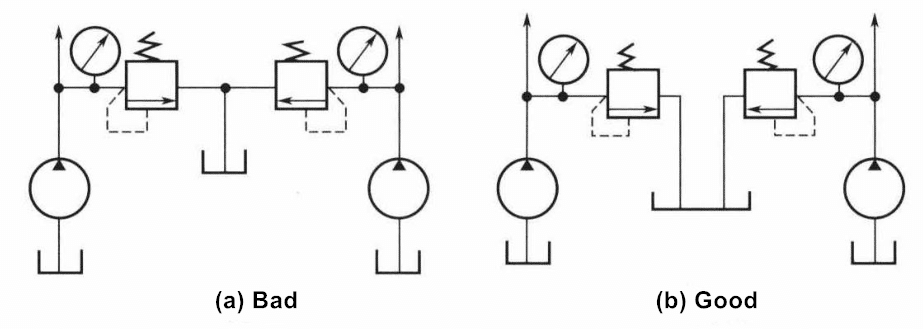
Figure 1-4 Relief valve piping
Resonance problem
Two relief valves with the same specifications and setting parameters are prone to resonance. As shown in Figure 1-5(a), the specifications and settings of the overflow valves A and B are the same. When two pumps are supplied in parallel, sometimes the overflow valve emits a strong noise. When the set pressure of the flow valve is staggered with each other, the noise can be eliminated. This shows that two relief valves with the same setting value are prone to resonance and should be avoided as much as possible. In addition, choose a relief valve and connect it to point C, as shown in Figure 1-5(b), the above-mentioned noise problem can also be solved.

Figure 1-5 Resonance of relief valve
Pressure reducing valve
When a part of the hydraulic system needs to obtain a stable pressure slightly lower than the supply pressure of the hydraulic pump, a pressure-reducing valve can be used. The pressure reducing valve whose outlet pressure is reduced and constant is called the fixed value pressure-reducing valve, referred to as the pressure reducing valve; the pressure reducing valve whose outlet pressure is constant with a certain load pressure is called the fixed differential pressure reducing valve; A pressure reducing valve with a certain ratio of inlet pressure to outlet pressure is called a constant ratio pressure reducing valve.
The requirements for the fixed-value pressure reducing valve are: no matter how the inlet pressure changes, the outlet pressure should be able to maintain a constant, and not be affected by changes in the flow through the valve. For fixed-differential or fixed-ratio pressure reducing valves, no matter how the inlet pressure or outlet pressure changes, the pressure difference or ratio should be constant.
Restrictions on the application of pressure reducing valve
- The pressure-reducing valve is a pressure regulating valve that makes the valve outlet pressure (secondary oil pressure) lower than the inlet pressure (primary oil pressure). Generally, the pressure reducing valve is a constant pressure type, and the valve hole gap of the pressure reducing valve is adjusted by itself according to the change of the inlet pressure, so it can automatically ensure that the outlet pressure of the valve is constant.
- The pressure reducing valve can also be used as a regulating device for stabilizing the working pressure of the oil circuit so that the pressure of the oil circuit is not affected by the change of the oil source pressure and the pressure fluctuation when other valves are working.
- The pressure reducing valve divides the hydraulic system into different pressure oil circuits according to different needs, such as the control oil circuit of the control mechanism or other auxiliary oil circuits, so that different actuators can produce different working forces.
- The pressure reducing valve is widely used in the system of throttling and speed regulation and the oil circuit of operating the spool valve. The pressure reducing valve is often connected in series with the throttle valve to ensure that the pressure difference before and after the throttle valve is constant, and the flow through the throttle valve does not change with the load.
- During application, the drain port of the pressure reducing valve must be directly connected to the fuel tank, and the drain path should be unblocked. If there is backpressure in the drain hole, it will affect the normal operation of the pressure-reducing valve and one-way pressure-reducing valve.
Pressure reducing valve overshoot
The overshoot phenomenon of the pressure-reducing valve is more serious. The greater the difference between the primary pressure and the secondary pressure, the greater the overshoot will be. Care should be taken when designing the system. The minimum adjustment pressure of the pressure-reducing valve should ensure that the difference between the primary pressure and the secondary pressure is 0.3 to 1 MPa.
Determining the flow rate of the pressure reducing valve
The setting pressure of the pressure-reducing valve depends on its working conditions. The pressure-reducing valve cannot control the output oil flow. When the flow after pressure reduction needs to be controlled, a flow control valve should be provided separately. The flow specification of the pressure-reducing valve should be selected by the maximum flow actually passing through the valve. On the one hand, do not make the flow through the pressure reducing valve and sequence valve much smaller than their rated flow, otherwise, vibration or other unstable phenomena are likely to occur. At this time, take necessary measures on the loop. On the other hand, the recommended rated flow should not be exceeded during use. The leakage of this kind of valve can be as high as 1L/min or more, and as long as the valve is in working condition, the leakage will always exist. This should be fully considered when selecting the capacity of the hydraulic pump.
Installation of pressure reducing valve
- The pressure reducing valve and the one-way pressure reducing valve connected by thread and flange has two oil inlets and one oil return.
- The valve and the one-way pressure reducing valve have an oil inlet and an oil return port. During installation, care must be taken to connect the drain port directly to the fuel tank and keep the drain path unobstructed. When the drain port has back pressure, it will cause the pressure reducing valve and the one-way pressure reducing valve to work abnormally.
- Adjust the handle clockwise to increase the pressure and adjust the handle counterclockwise to decrease the pressure.
- When it is necessary to connect a pressure gauge to measure the inlet pressure, screw out the M14×1.5 screw plug plugged on the shell and replace it with the corresponding pipe joint.
- When the valve is working, it is often caused by air infiltration to emulsify the oil and cause pressure fluctuations and noise. Therefore, care must be taken not to allow air to enter the oil.
- When the pressure of the oil pump and the oil circuit is normal, and the pressure of the secondary oil circuit of the pressure reducing valve is too low or the pressure is equal to zero, the valve cover should be disassembled to check whether the drainpipe is blocked, the pressure regulating cone and the orifice are clean.
- When using the remote control, the screw plug of the remote control port can be unscrewed and connected to the control oil circuit.


Ciao, puoi inviarmi il tuo catalogo?